ThermoGrid vs ServiceTitan vs Housecall Pro vs Jobber
Which platform is the best for contractors?
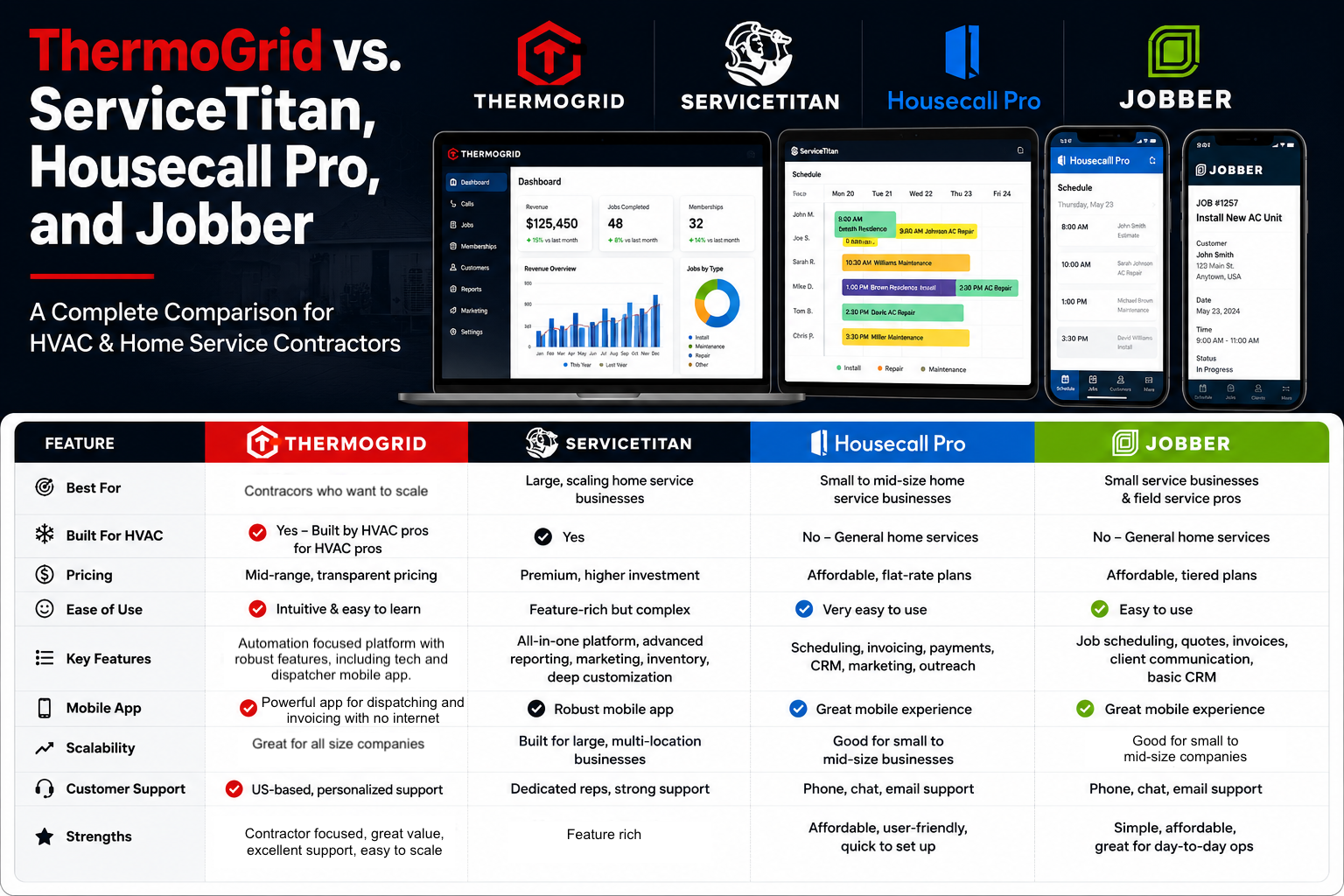
Choosing the right field service management software can dramatically impact your company’s profitability, efficiency, customer experience, and long term growth. For HVAC, plumbing, electrical, and home service companies, the software platform you choose becomes the operating system of your business.
In this comparison, we break down the differences between ThermoGrid, ServiceTitan, Housecall Pro, and Jobber so contractors can better understand which platform best fits their business size, operational complexity, and growth goals.
Quick Overview
ThermoGrid
Best For
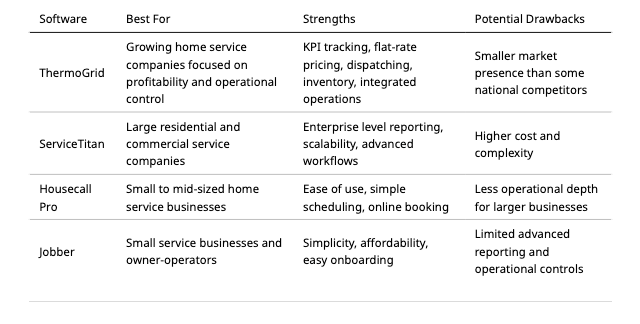
ThermoGrid is ideal for HVAC, plumbing, electrical, and field service companies that want strong operational visibility, profitability tracking, dispatching, pricing control, and integrated workflows without the complexity many enterprise platforms introduce. This is a great platform to go from a small company to a mid-level to and even large service company.
Key Features
- Smart dispatching
- Flat-rate pricing wizard
- KPI and profitability reporting
- Scheduling and invoicing
- Online scheduling and Auto Reminders
- Review Management
- Inventory management
- Marketing automation
- Service agreements
- Mobile technician & dispatcher tools
- QuickBooks & Payment integrations
- Equipment and customer history tracking
ThermoGrid focuses heavily on helping contractors improve operational efficiency and profitability instead of simply digitizing paperwork.
One major differentiator is the emphasis on KPI visibility and business performance tracking. Contractors can monitor job profitability, recurring revenue, technician performance, average tickets, memberships, and operational metrics from a centralized automatic dashboard.
ThermoGrid also includes integrated flat-rate pricing tools designed to help contractors maintain margins and eliminate pricing inconsistencies.
Pros
- Designed specifically around contractor workflows
- Strong operational and profitability focus
- Integrated pricing and KPI management
- Flexible for multiple trades
- Good balance between power and usability
- Internal RISE Coaching for business growth
Cons
- Smaller brand recognition compared to ServiceTitan
- Fewer third-party ecosystem integrations than enterprise competitors
ServiceTitan
Best For
ServiceTitan is often viewed as an enterprise-grade platform for larger HVAC, plumbing, electrical, garage door, roofing, and commercial service organizations.
It is commonly used by companies with larger teams, multiple locations, extensive reporting needs, and complex operational structures.
Key Features
- Advanced scheduling and dispatching
- Enterprise reporting and analytics
- Technician mobile app
- Financing integration
- Call tracking
- Marketing tools
- Sales tracking
- Inventory and purchasing workflows
- Commercial service management
- Real-time dashboards
ServiceTitan has built a strong reputation for helping large contractors centralize operations and scale.
The platform is known for deep reporting capabilities and advanced workflow management. Larger companies often appreciate the level of operational visibility and customization available.
Pros
- Highly scalable
- Strong enterprise reporting
- Robust commercial workflows
- Large integration ecosystem
- Widely recognized brand in the trades
Cons
- Higher implementation costs
- More complex onboarding and training
- Can feel overwhelming for smaller companies
- Higher monthly investment compared to simpler platforms
Housecall Pro
Best For
Housecall Pro is best suited for small to mid-sized residential service companies looking for an easy-to-use platform with scheduling, dispatching, invoicing, and customer communication tools.
It is especially attractive to companies wanting a fast setup process and straightforward workflows.
Key Features
- Scheduling and dispatching
- Online booking
- Invoicing and payments
- Review management
- Automated reminders
- Technician tracking
- Mobile app
- Estimates and proposals
- Customer communication tools
Housecall Pro emphasizes simplicity and ease of use.
For companies transitioning from spreadsheets, paper invoices, or basic scheduling systems, Housecall Pro can significantly improve organization and customer communication.
Pros
- Easy to learn and implement
- Clean interface
- Good customer communication features
- Strong online booking tools
- Lower learning curve
Cons
- Less operational depth for scaling businesses
- Limited advanced KPI tracking
- Fewer enterprise-level management controls
- Can become limiting as operational complexity increases
Jobber
Best For
Jobber is often ideal for owner-operators, startups, and small service businesses that need basic scheduling, invoicing, quoting, and customer management.
It focuses heavily on simplicity and affordability.
Key Features
- Scheduling
- Quotes and invoicing
- Online payments
- Client management
- Route optimization
- Mobile app
- Automated reminders
- Basic reporting
Jobber is popular among lawn care, cleaning, handyman, pressure washing, and smaller home service businesses.
Its interface is designed to be easy for companies with limited office staff or technical experience.
Pros
- Very user friendly
- Affordable entry point
- Fast setup
- Good for smaller teams
- Strong mobile usability
Cons
- Limited advanced reporting
- Less customization
- Fewer operational controls for larger companies
- Not as robust for complex HVAC or commercial operations
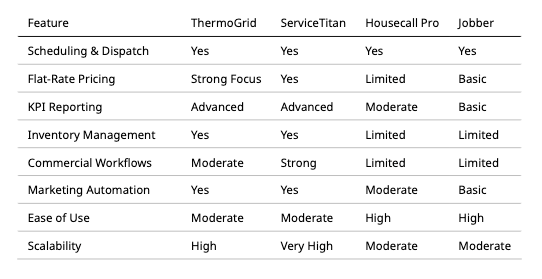
Feature Comparison
Which Platform Is Right For Your Business?
Choose ThermoGrid If:
- You want operational visibility and profitability tracking
- You need strong flat-rate pricing and KPI management
- You want contractor-focused workflows
- You are scaling and want deeper operational control
- You want strong contractor-focused capabilities
Choose ServiceTitan If:
- You operate a large or enterprise-level service company
- You need advanced commercial workflows
- You have multiple locations
- You want highly advanced reporting and integrations
- Budget is less of a concern than scalability
Choose Housecall Pro If:
- You want something easy to implement quickly
- You run a small to mid-sized residential service company
- You prioritize customer communication and online booking
- You want a lower learning curve
Choose Jobber If:
- You are an owner-operator or startup
- You need affordable software
- Your workflows are relatively simple
- You prioritize ease of use over advanced operational depth
Final Thoughts
Every field service platform has strengths. Every platform has successful contractors using them.
The best software is not necessarily the one with the most features. It is the platform that best aligns with your company’s size, operational complexity, growth goals, and management style.
Smaller companies may value simplicity and fast onboarding. Larger organizations often require advanced reporting, workflow automation, and operational visibility.
ThermoGrid positions itself as a contractor-focused platform built around profitability, dispatching efficiency, KPI management, and operational control for growing service companies.
ServiceTitan is often favored by larger enterprise operations needing highly advanced workflows and scalability.
Housecall Pro and Jobber remain strong choices for smaller businesses prioritizing simplicity, affordability, and ease of use.
Before choosing a platform, contractors should evaluate:
- Support
- Training
- Reporting depth
- Dispatching capabilities
- Mobile app usability
- Inventory tracking
- Pricing management
- Customer communication
- Training and onboarding requirements
- Scalability
- Total long-term operational impact
The right software can help contractors improve efficiency, increase profitability, create a better customer experience, and build a more scalable business.
Sources
This article was informed by publicly available feature and product information from official company websites and software directories, including ThermoGrid, ServiceTitan, Housecall Pro, Capterra, GetApp, and Software Advice.
ThermoGrid®, ServiceTitan®, Housecall Pro®, and Jobber® are trademarks of their respective owners. This comparison is for informational purposes only and is based on publicly available information at the time of publication.